

Dental implant vs bridge: how do you replace one missing tooth?
A dental implant and a dental bridge can both replace a missing tooth, but they use different support. The right option depends on the neighbouring teeth, available bone, oral health, treatment time and your priorities.
In this guide
The condition of the whole space matters.
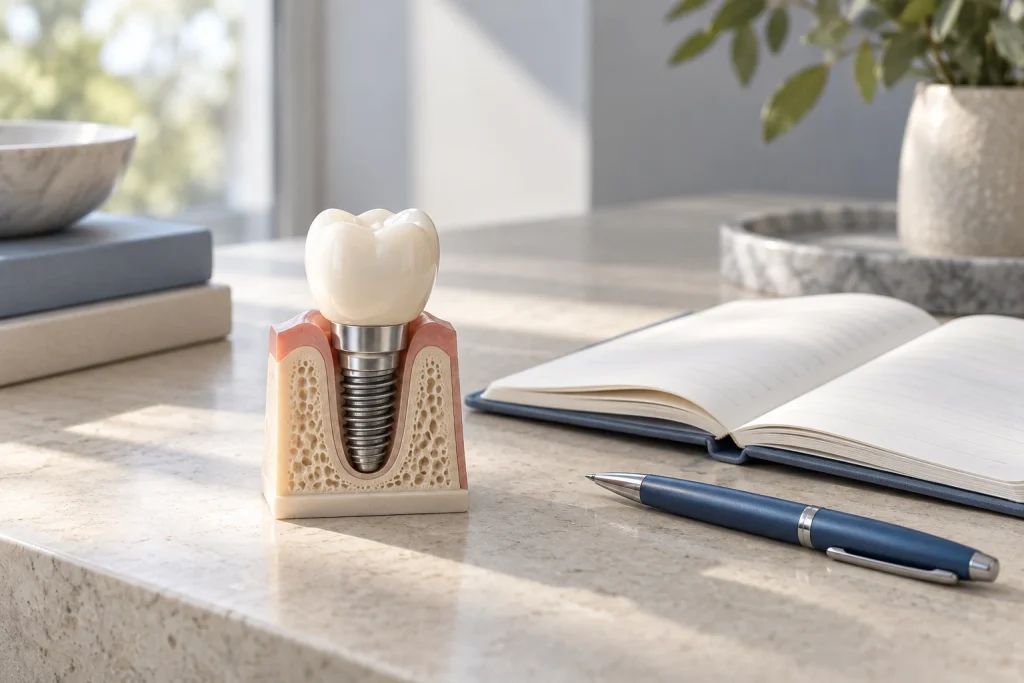
An implant replaces the missing tooth root with a fixture placed in the jawbone, which supports a crown after healing. A conventional bridge replaces the visible tooth by connecting a false tooth to crowns placed over teeth beside the gap.
An implant avoids using neighbouring teeth for support, but it involves surgery, healing time and sufficient bone. A bridge avoids implant surgery and can often be completed sooner, but the supporting teeth usually need to be reshaped. Neither option is universally preferable.
The key question is not simply “implant or bridge?” It is whether the teeth beside the space are healthy and untouched, already heavily restored, or in need of crowns, and whether the bone and gums can support implant treatment.
How each option replaces the tooth.
Single dental implant
The implant fixture is surgically placed into the jawbone. After the site is stable and healed, an abutment and custom crown are attached.
- Supported independently in the jawbone
- Does not normally require crowns on adjacent teeth
- Requires assessment of bone, gums and general health
- Treatment commonly involves a healing period before the final crown
Conventional dental bridge
A false tooth is joined to crowns or retainers on the neighbouring teeth. The connected restoration spans the gap and is fixed in place.
- Supported by teeth beside the gap
- Usually avoids implant surgery
- May be useful when neighbouring teeth already need crowns
- Requires specific cleaning beneath the joined restoration
Other designs may be possible, including resin-bonded bridges, implant-supported bridges and removable partial dentures. The number and position of missing teeth can change the available options.
Compare the practical differences.
| Consideration | Implant | Bridge |
|---|---|---|
| Support | Jawbone through an implant fixture | Neighbouring teeth or, in some designs, implants |
| Procedure | Includes surgery | Usually involves preparing supporting teeth |
| Timing | May require months of staged healing | Often completed over several appointments in a shorter sequence |
| Neighbouring teeth | Usually left independent | May need reshaping for crowns or retainers |
| Cleaning | Cleaned around like a separate tooth with tailored advice | Requires cleaning beneath the connected false tooth |
| Additional needs | May require extraction, grafting or other preparation | Supporting teeth must be strong enough for the design |
Fees cannot be compared fairly without checking what is included. Elite Dentistry’s dental implant cost guide explains why imaging, extraction, grafting, the implant components and the final crown can change a complete quote.
What changes the recommendation?
- The adjacent teeth: untouched healthy teeth may favour preserving them; heavily filled or weakened teeth may already need restorative treatment.
- Bone and gum health: implant treatment requires adequate support and stable oral health. Additional procedures may be considered where bone volume is limited.
- Medical history and smoking: healing and surgical suitability need individual assessment.
- Location of the gap: bite forces, visible aesthetics and space differ between front and back teeth.
- Treatment timing: a bridge and an implant follow different sequences. A temporary tooth may be needed while the site heals.
- Maintenance: both options need daily cleaning and professional review, but the techniques differ.
A consultation should also consider whether the missing tooth site is stable now or whether an extraction has only recently occurred. Leaving a space, choosing a removable option or delaying definitive treatment may also be appropriate in selected circumstances.
Questions to ask before deciding.
- Are the teeth beside the gap healthy, or do they already need crowns?
- Do I have enough bone and healthy gum tissue for an implant?
- What stages and components are included in each quote?
- Will I need extraction, grafting, imaging or a temporary tooth?
- How long will each treatment pathway take in my case?
- How do I clean around the final restoration?
- What are the material risks and alternatives for my situation?
Ask for a written treatment plan that identifies the proposed restoration, preparatory care, likely sequence and review requirements. The lowest initial figure is not necessarily the lowest complete cost.
Implant and bridge FAQs.
Does a bridge always require two teeth to be filed down?
A conventional bridge commonly uses crowned teeth on either side of the gap, but other designs exist. Suitability depends on the location, bite and condition of the supporting teeth.
Can a bridge be supported by implants?
Yes. An implant-supported bridge may replace several missing teeth. The design and number of implants are planned according to the site, bone and functional requirements.
What if there is not enough bone for an implant?
Your dentist may discuss bone grafting, a different implant plan, a bridge, a removable denture or leaving the space. The suitable options depend on the anatomy and overall treatment goals.
Can I have a temporary tooth while treatment is underway?
Temporary options are available in many cases, but the design depends on the site and treatment stage. This should be included in the planning discussion.
Compare both options with your own teeth in view.
Elite Dentistry in Neutral Bay can assess the missing-tooth space, neighbouring teeth, bone and gums, then explain which replacement pathways may be suitable.
This article provides general information and is not a substitute for individual dental advice. Treatment suitability, risks and outcomes vary.
Medically Reviewed by Dr Angelo Economos
Principal Dentist at Elite Dentistry Neutral Bay. Bachelor of Dental Surgery with Honours (University of Sydney, 1994) with 30+ years of clinical experience in cosmetic, restorative, and implant dentistry.




1 comment